The SPACE analytics dashboard: unlocking Developer Productivity through data-driven, actionable insights

The SPACE analytics dashboard: unlocking Developer Productivity through data-driven, actionable insights

While the SPACE framework provides a robust conceptual model to analyze Developer Productivity, the challenge lies in translating these dimensions into tangible, measurable insights. This is precisely where the Keypup SPACE Software Development Lifecycle (SDLC) analytics dashboard becomes indispensable. It moves beyond subjective assessments and provides factual data to understand, diagnose, and improve the development ecosystem.

Thomas Williams
Keypup's New API: Supercharge Your Development Workflow and Unleash Your Team's True Potential

Keypup's New API: Supercharge Your Development Workflow and Unleash Your Team's True Potential

Unlock the full potential of your DevOps workflow with the newly released Keypup API. Seamlessly integrate Keypup's powerful insights into your existing tools, automate tasks, and gain unprecedented visibility into your development process. Learn how to create custom Slack bots for streamlined standups, set up proactive monitoring alerts with tools like Datadog and New Relic, and build intelligent, data-driven DevOps flows that adapt to your team's needs. Enhance your team's productivity and build better software, faster, with the Keypup API.

Arnaud Lachaume
Measuring a Development Team’s Performance: a practical Customer Use Case

Measuring a Development Team’s Performance: a practical Customer Use Case

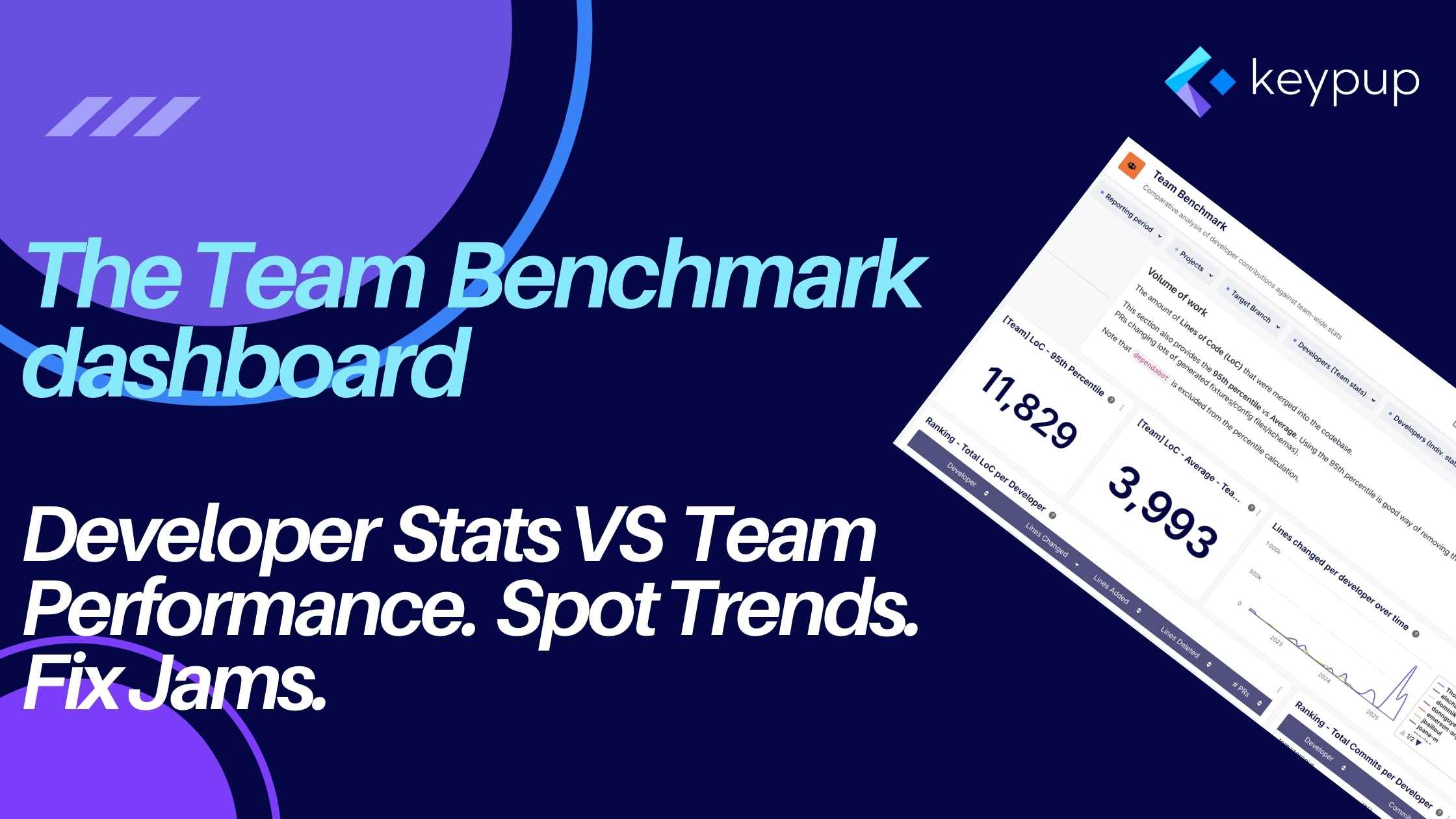
Understanding and optimizing development team performance is a critical concern for engineering leaders. Recently, a customer reached out expressing their pressing need: "We are facing some problems about our dev team performance. Do you have a bunch or metrics that could help us compare and check the people performance?" This interaction highlighted a common challenge – a lack of clear metrics and tools to assess and improve team effectiveness. This blog post explores their situation and our data-driven approach to helping them gain valuable insights.

Thomas Williams
Assessing the Efficiency of AI-Driven Development: 2 methods of quantitative evaluation of the impact of AI usage in Software Development

Assessing the Efficiency of AI-Driven Development: 2 methods of quantitative evaluation of the impact of AI usage in Software Development

How can organizations objectively measure the impact of AI on their development teams? This article looks into two different approaches to conduct this quantitative evaluation. The first approach consists in evaluating the impact of AI tools uniformly in a given team, by comparing the overall Software Development Life Cycle (SDLC) performance before and after implementation of AI tools, whilst the second is comparative, and will compare the SDLC performance between 2 groups of developers: one that uses AI tools, and the other one that does not.

Thomas Williams
The Future of Tech: AI vs Traditional Software Development - Exploring & measuring the Pros and Cons

The Future of Tech: AI vs Traditional Software Development - Exploring & measuring the Pros and Cons

In the age of rapid technological advancements, the future of tech is a subject of great interest and debate. One of the most intriguing discussions revolves around the comparison between Artificial Intelligence (AI) and traditional software development. Exploring the pros and cons of AI and traditional software development can help us make informed decisions about which technology to adopt. In this article, we will delve into these aspects, examining the benefits and limitations of each approach and how to measure their respective merits.

Arnaud Lachaume
Evaluating the Impact, ROI and Efficiency of AI-Driven Software Development

Evaluating the Impact, ROI and Efficiency of AI-Driven Software Development

AI-driven software development can represent a transformative force in the tech industry. The benefits of AI-driven solutions, such as accelerated development cycles and improved project management, position businesses to thrive in a competitive landscape. Assessing the real the impact of AI-driven software development, however, is crucial for maximizing its benefits. By establishing clear KPIs and analyzing both quantitative and qualitative data, organizations can gain valuable insights into how AI is transforming their development processes and whether the Return on investment of AI-driven development is matching expectations. This data-driven approach allows for continuous improvement, optimized AI adoption, and ultimately, the delivery of higher-quality software faster, more efficiently.

Thomas Williams

The Power of Efficiency: How Reduced Cycle Time Directly Impacts Your Success

The Power of Efficiency: How Reduced Cycle Time Directly Impacts Your Success

In a fast-paced world where every second counts, efficiency is key to staying ahead. That's why reducing cycle time has become a crucial focus for businesses across industries. By streamlining processes and eliminating unnecessary steps, organizations can significantly improve productivity, cost-effectiveness, and customer satisfaction.

Stephane Ibos
Understanding the Differences & Complementarity of Issue Cycle Time and Pull Request Cycle Time

Understanding the Differences & Complementarity of Issue Cycle Time and Pull Request Cycle Time

In the world of software development, speed and efficiency are paramount. Teams strive to deliver value to users quickly and consistently. To achieve this, it's crucial to track and optimize various metrics that provide insights into the development process. Two prominent metrics that have become increasingly important are Issue Cycle Time and Pull Request Cycle Time. While often confused, these metrics offer distinct perspectives on the development process, revealing different aspects of team performance and bottlenecks.

Arnaud Lachaume
Boosting Efficiency and Productivity: Unleashing the Power of JIRA Cycle Time with Keypup

Boosting Efficiency and Productivity: Unleashing the Power of JIRA Cycle Time with Keypup

Whether you're a small start-up or a large enterprise, JIRA Cycle Time, combined with Keypup's Cycle Time products, offers the perfect solution for streamlining your processes and getting tasks completed faster. By assessing the time it takes for an issue to move through your workflow, Cycle Time analysis provides valuable insights into areas for improvement, allowing you to identify bottlenecks and optimize your team's performance.

Stephane Ibos